Source Hospital Hybrid Bedside Table for Offices, Pharmacies, and Treatment Rooms
Compare 30 hospital hybrid bedside table options featuring materials like plastic, wood, and metal. These functional cabinets offer easy disinfection, dampproofing, and fireproof features suitable for offices, pharmacies, and treatment rooms with varying layer counts and customization needs.
Key considerations
Products List




Comprehensive Sourcing Guide
Strategic Sourcing Guide for Hospital Hybrid Bedside Tables
Procuring medical-grade furniture requires a rigorous approach that balances clinical functionality, regulatory compliance, and total cost of ownership. The hospital hybrid bedside table represents a specialized category of equipment designed to support patient care while maintaining strict hygiene standards. Unlike standard residential furniture, these units must withstand frequent disinfection, resist cross-infection, and integrate seamlessly into clinical workflows. This guide outlines the critical factors buyers must evaluate when sourcing these units, drawing on observed market data and industry standards to ensure a robust procurement strategy.
Technical Specifications and Material Composition
The foundation of a successful procurement decision lies in understanding the specific technical attributes of the product. In the current market, hybrid bedside tables are constructed from a variety of materials, each offering distinct advantages for hospital environments. Observed listings indicate that these units are frequently manufactured from plastic, wood, and metal. The choice of material directly influences the unit's durability, weight, and resistance to chemical agents used in hospital cleaning protocols.
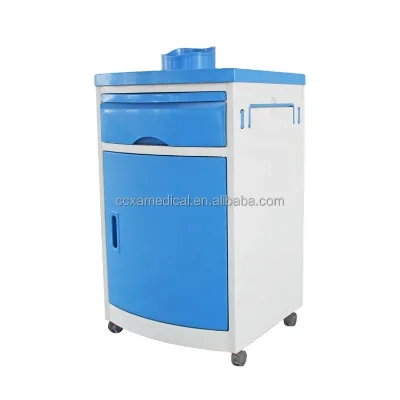
Plastic models are often highlighted for their "Easy Disinfection" and "Dampproof" capabilities, making them ideal for high-moisture areas or wards requiring frequent sanitation. These units may feature a "Nature Color" or specific clinical shades like "Blue" to aid in visual identification and aesthetic integration. Conversely, wooden variants are noted for their "Nature Color" and specific applications in pharmacy or office treatment areas, though they may require different maintenance protocols regarding moisture resistance. Metal constructions, often associated with "Steel" standards, provide structural integrity and are frequently cited in models designed for heavy-duty usage.
Layer configuration is another critical specification. Market observations reveal units ranging from 2 to 4 layers, with some models specifically designed as "Functional Cabinets" or "Bedside Cabinet Locker Tables." The number of layers dictates storage capacity and the organization of medical supplies, patient items, and personal effects. For instance, a 3-layer unit might offer a balance between compactness and utility, while a 4-layer model could be preferred for departments requiring extensive storage. Buyers must verify the exact "Top Size" specifications, as observed dimensions such as 900 x 400mm (35 x 15½") are common, but variations exist. The physical footprint must align with the spatial constraints of the patient room or treatment area.
Compliance and Certification Verification
In the healthcare sector, compliance is not merely a formality but a prerequisite for safety and liability protection. When sourcing hospital hybrid bedside tables, buyers must rigorously verify the certification status of the products. The market data indicates that reputable manufacturers often provide certifications such as FDA and ISO. These certifications suggest that the materials and manufacturing processes meet specific safety and quality benchmarks required for medical environments.
The "ISO CE" standard is frequently mentioned in product descriptions, indicating adherence to European safety, health, and environmental protection standards. However, buyers should not assume that all listed products possess these certifications without explicit verification. The presence of a "1 Year" warranty is a common attribute observed in the market, which serves as an indicator of the manufacturer's confidence in product longevity. However, warranty terms can vary significantly, and the specific coverage details must be clarified in the purchase agreement.
Furthermore, the "Standard" attribute for these units often references specific dimensional or material benchmarks, such as "480480760mm" or "S&L" standards. These standards define the physical and functional requirements of the product. Buyers should ensure that the product's standard designation aligns with local regulatory requirements and hospital internal policies. For example, a unit marked with "Steel" as a standard may imply a specific grade of metal alloy, which must be confirmed to ensure it meets fire-resistant or anti-corrosion requirements.
Cost Drivers and Pricing Dynamics
Understanding the cost structure of hospital hybrid bedside tables is essential for budget management. The observed price range in the market spans from $0.10 to $90.00 USD. This wide variance suggests that pricing is heavily influenced by material composition, customization options, and order volume. Plastic units with basic features may fall at the lower end of the spectrum, while complex metal or wooden units with advanced features like "Fireproof" and "Anti-Cross-Infection" capabilities may command higher prices.
Minimum Order Quantity (MOQ) is a significant factor affecting the unit cost. Data indicates that MOQs can range from 1 to 100 pieces, with specific models requiring 50 or 100 pieces. Bulk purchasing often leads to economies of scale, reducing the per-unit cost. However, buyers must balance the need for volume discounts against storage costs and the risk of obsolescence. Customization is another cost driver; while some models are "Non-Customized," others offer "Customized" options. Customization typically involves additional engineering, tooling, and production time, which can increase the overall cost.
The "prod_packing" method, such as "Carton" or "Blister Card," also impacts logistics costs. Robust packaging is necessary to prevent damage during transit, especially for units with glass-free windows or fragile components. Buyers should factor in the cost of specialized packaging when calculating the total landed cost of the procurement.
Typical Applications and Functional Requirements
The application of hospital hybrid bedside tables varies depending on the specific department and patient needs. Observed usage scenarios include "Hospital," "Pharmacy," "Office Treatment," and general "Office Treatment" areas. In a hospital setting, the primary function is to provide a stable surface for medical equipment, patient meals, and personal items while maintaining a sterile environment. The "Easy Disinfection" feature is paramount in these settings to prevent the spread of pathogens.
For pharmacy and office treatment areas, the focus may shift towards storage security and organization. Models described as "Functional Cabinets" or "Bedside Cabinet Locker Tables" are particularly suited for these environments. These units often feature "Fireproof" and "Abrasion Resistant" properties, ensuring safety and longevity in high-traffic areas. The "Folded" attribute observed in some wooden models suggests a need for space-saving solutions in smaller treatment rooms or temporary setups.
The "Window" specification is another consideration. Many units are listed as "Without Glass Window," which simplifies cleaning and reduces the risk of breakage. However, specific clinical needs may require visibility into storage compartments, necessitating a different design. Buyers must assess the specific workflow of the intended department to determine the optimal configuration.
Supplier Evaluation and Sourcing Strategy
Evaluating suppliers requires a multi-faceted approach that goes beyond price comparison. The origin of the products is a key indicator of supply chain reliability. Most observed listings indicate an origin in "China," with specific manufacturing hubs like "Hebei" noted. While these regions are known for manufacturing capabilities, buyers must verify the supplier's ability to maintain consistent quality and adhere to delivery schedules.
The "Customization" availability is a critical differentiator. Suppliers offering "Customized" options demonstrate flexibility and a willingness to tailor products to specific hospital requirements. However, this also introduces complexity in the procurement process, requiring clear communication of specifications and timelines. Buyers should prioritize suppliers who can provide detailed technical documentation and demonstrate a track record of fulfilling medical-grade orders.
Lead times and production capacity are also vital considerations. While specific lead times are not explicitly detailed in the provided data, the complexity of customization and the MOQ requirements suggest that production schedules may vary. Buyers should establish clear expectations regarding delivery dates and include penalties for delays in their contracts. Additionally, the "Condition" of the products is listed as "New," which is a standard expectation, but buyers should verify that the products are indeed new and not refurbished or second-hand.
Quality Control and Long-Term Procurement Considerations
Ensuring long-term value requires a robust quality control (QC) framework. Buyers should implement pre-shipment inspections to verify that the products meet the specified standards and certifications. Key quality metrics include the integrity of the "Easy Disinfection" surfaces, the stability of the "Layer" structure, and the accuracy of the "Top Size" dimensions. For units with "Fireproof" and "Anti-Cross-Infection" features, third-party testing reports should be requested to validate these claims.
Long-term procurement considerations involve the total cost of ownership, including maintenance, replacement, and disposal. The "1 Year" warranty is a starting point, but buyers should negotiate extended warranty terms or service level agreements that cover routine maintenance and part replacements. The "Material" choice also impacts longevity; for instance, metal units may offer superior durability in high-traffic areas compared to plastic or wood.
Sustainability is an emerging consideration in healthcare procurement. Buyers should inquire about the recyclability of the materials used, particularly for plastic and metal units. The "prod_packing" method should also be evaluated for its environmental impact, with a preference for recyclable or biodegradable packaging materials.
Comparative Analysis of Product Attributes
To facilitate decision-making, the following table summarizes key attributes observed in the market for hospital hybrid bedside tables. This comparison highlights the diversity in specifications and helps buyers identify the most suitable options for their specific needs.
| Attribute | Observation A | Observation B | Observation C |
|---|---|---|---|
| Material | Plastic | Wood | Metal |
| Layer Count | 2 Layers | 3 Layers | 4 Layers |
| Key Features | Easy Disinfection, Dampproof | Easy Disinfection, Fireproof, Anti-Cross-Infection | Easy Disinfection, Dampproof, Fireproof |
| Color | Blue | Nature Color | Nature Color |
| Certification | FDA, ISO | ISO | ISO |
| MOQ | 100 PCS | 50 PCS | 100 PCS |
| Origin | China | China | Hebei |
| Application | Hospital | Pharmacy, Office Treatment | Office Treatment |
| Customization | Available | Non-Customized | Customized |
| Warranty | 1 Year | 1 Year | 1 Year |
This table illustrates that while core features like "Easy Disinfection" are common, the material and customization options vary significantly. Buyers must weigh these differences against their specific operational requirements. For example, a hospital requiring high-volume storage might prioritize the 4-layer metal unit, while a pharmacy might prefer the 3-layer wooden unit with "Anti-Cross-Infection" features.
In conclusion, sourcing hospital hybrid bedside tables requires a meticulous evaluation of technical specifications, compliance, cost drivers, and supplier capabilities. By adhering to the guidelines outlined in this guide, buyers can make informed decisions that ensure the safety, efficiency, and longevity of their medical furniture investments. The complexity of the market demands a strategic approach that balances immediate needs with long-term value, ensuring that the selected products meet the rigorous standards of the healthcare industry.
FAQs
What materials are used for hospital hybrid bedside tables?
These tables are constructed from plastic, wood, or metal depending on the model. Plastic units offer easy disinfection and dampproof features, while wooden variants suit pharmacy and office treatment areas with nature color finishes.
Which certifications should buyers verify for medical furniture?
Reputable units often carry FDA and ISO certifications to ensure safety and quality. Some products also meet ISO CE standards, but buyers must explicitly verify these credentials rather than assuming compliance based on general market descriptions.
How many layers do these bedside cabinets typically have?
Observed models range from 2 to 4 layers to accommodate different storage needs. A 3-layer unit balances compactness with utility, while 4-layer options provide extensive storage for departments requiring more organization of medical supplies.
Can these tables be customized for specific hospital requirements?
Customization is available for some models, while others are sold as non-customized standard units. Buyers should check specific product attributes like model numbers SHT-605 or BC159 to determine if tailored dimensions or features are possible.
What is the typical minimum order quantity for these units?
Minimum order quantities vary, with some models requiring 50 pieces and others 100 pieces. Bulk purchasing often reduces unit costs, so buyers must confirm the specific MOQ for their selected model before placing an order.
Where are these hospital furniture items typically manufactured?
Most observed listings indicate an origin in China, with specific manufacturing hubs noted in Hebei. Buyers should verify the exact production location to ensure supply chain reliability and alignment with local regulatory requirements.